Avatar: Fire and Ash: James Cameron Burns Down the Paradise
- Category: Action, Sci-Fi, Fantasy, Adventure
- Release Date: December 19, 2025
- Cast: Sam Worthington, Zoe Saldana, Sigourney Weaver, Stephen Lang, Oona Chaplin, Jack Champion
- Language: English
- Duration: 3h 17m
- Director: James Cameron
If there is one immutable law in the universe of cinema, it is this: never bet against James Cameron. Three years after diving into the depths with The Way of Water, the visionary director returns to Pandora to complete the next leg of his monolithic saga. Released on December 19, 2025, Avatar: Fire and Ash (Local title: Avatar: Ateş ve Kül) marks a drastic tonal shift for the franchise. We are no longer merely exploring the bioluminescent wonders of the forest or the serene majesty of the reefs. Now, we are walking into the fire.
With a staggering runtime of 3 hours and 17 minutes, this third installment is an endurance test, but one that rewards the viewer with visuals that arguably surpass its predecessors. However, beneath the technological wizardry lies a darker, grittier narrative. The film trades the clear-cut “good vs. evil” dynamic of the first two movies for a morally complex gray area, introducing us to a side of the Na’vi that we never knew existed: the aggressive, volcanic Ash People. For the audience on fmovies.tr, this is the blockbuster event of the year, but it demands patience and a strong stomach for emotional turmoil.
The Plot: From Grief to the Volcano
The narrative picks up shortly after the devastating conclusion of the second film. The Sully family is fractured. The death of Neteyam hangs over them like a shroud, transforming the once vibrant family dynamic into one of silence and suppressed rage. Jake Sully (Sam Worthington) and Neytiri (Zoe Saldana) are finding it impossible to return to “normal” life among the Metkayina clan. The ocean, once a place of discovery, is now a reminder of what they lost fighting the RDA.
Realizing that their presence endangers the water tribes, and with the human threat (RDA) regrouping for a massive assault, the family decides to move. However, the journey is not a retreat; it is a forced migration. They realize that Spider (Jack Champion) can no longer be kept safe—or perhaps, trusted fully—given his lineage. The decision to relocate leads them into uncharted territory: the volcanic regions of Pandora.
Enter the Mangkwan Clan
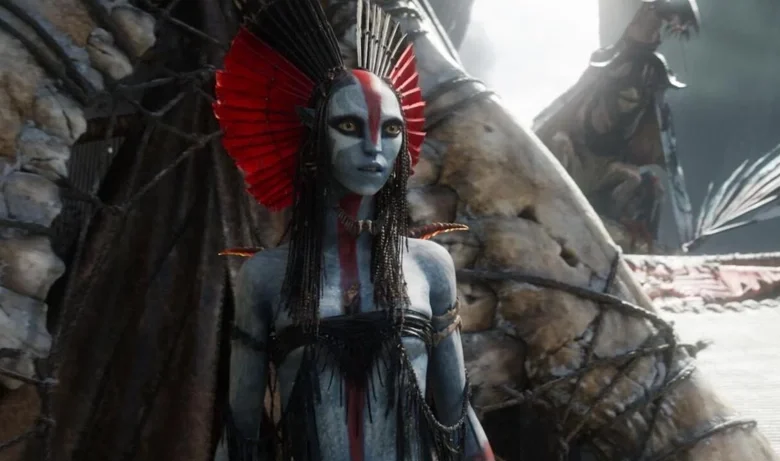
This is where the script, co-written by Cameron and Rick Jaffa, introduces the game-changer: the Mangkwan Clan, also known as the “Ash People.” Unlike the Omatikaya (who represent Earth/Forest) or the Metkayina (Water), the Ash People represent Fire. They are not the noble savages we are used to. Having survived the destruction of their homeland by volcanic activity, they have adapted to a harsh, soot-covered existence. They are militaristic, xenophobic, and unlike other Na’vi, they do not necessarily view Eywa as a benevolent mother, but as a cruel tester of strength.
The Sully family is ambushed by this clan, setting the stage for a three-way conflict. It is no longer just Na’vi versus Humans. It is Na’vi versus Na’vi, with the RDA capitalizing on the chaos. This internal conflict within the indigenous population adds a layer of political intrigue that the franchise desperately needed.
Director’s Vision: Painting with Fire and Soot
Visually, Avatar: Fire and Ash is a masterpiece of contrast. Where the previous film was bathed in cool blues and cyans, this film is dominated by aggressive reds, obsidians, and greys. James Cameron and his Weta FX team have somehow solved the physics of rendering ash particles, lava flows, and firelight in a 3D environment with photorealistic precision.
The 3D experience here is utilized not just for depth, but for atmosphere. The falling ash creates a constant sense of claustrophobia and decay, mirroring the grief of the characters. Cameron also leans into the “fantasy” element of the genre more than ever. The creatures of the volcanic biome—armored, spiked, and heat-resistant—feel like they belong to a different planet entirely compared to the banshees of the first film.
The Cast: A Study in Sorrow and Rage
While the visuals are the hook, the performances are the anchor. The motion capture technology has advanced to the point where every micro-expression of grief is visible.
- Zoe Saldana as Neytiri: If the second film sidelined her slightly, this film puts her front and center. Neytiri is a mother in mourning, and her grief has curdled into a terrifying rage. Saldana delivers a performance that is feral and heartbreaking. She is no longer just fighting for survival; she is fighting for vengeance, often clashing with Jake’s more tactical approach.
- Sam Worthington as Jake Sully: Jake is weary. He is a general fighting a war that never ends. Worthington plays him with a heavy stoicism, portraying a father who is failing to hold his family together.
- Sigourney Weaver as Kiri: The mystery of Kiri deepens. Her connection to Eywa becomes pivotal as she interacts with the Ash People, who view her abilities with suspicion rather than reverence. Weaver captures the ethereal, otherworldly nature of the character perfectly.
- Oona Chaplin as Varang: The leader of the Ash People. Chaplin is a standout addition. She brings a ruthless, cold charisma to the role, presenting a villain who believes she is the hero of her own story. She challenges the Sully family’s morality, asking what use “peace” is in a world of constant war.
Critical Review: The Spectacle vs. The Fatigue
Avatar: Fire and Ash is a cinematic triumph, but it is not without its flaws. As noted by local critics, there is a sense of repetition in the broader strokes of the plot.
The “War Fatigue”
One valid criticism is that Jake Sully seems to be fighting the same battle for the third time. The RDA returns, the family runs, a battle ensues. While the setting changes, the core loop remains. However, the introduction of the “Evil Na’vi” disrupts this enough to keep it engaging. For the first time, the Na’vi are not portrayed as a monolith of virtue. This complexity saves the film from feeling like a re-skin of The Way of Water.
Pacing and Runtime
At 3 hours and 17 minutes, the film demands commitment. The second act, which explores the culture of the Ash People, is fascinating but slow. Cameron indulges in long, dialogue-free sequences of world-building. For fans of Pandora, this is heaven. For casual viewers, it might feel like a National Geographic documentary from another planet. Yet, the final hour—a massive, multi-front battle amidst an active volcanic eruption—is perhaps the greatest action sequence Cameron has ever directed.
Avatar: Fire and Ash is a darker, angrier, and more visually aggressive beast than its predecessors. It successfully expands the lore of Pandora, proving that the planet is as dangerous as it is beautiful. It tackles heavy themes of grief, xenophobia, and the cycle of violence. While the runtime is daunting and the plot occasionally treads familiar ground, the sheer scale of the achievement is undeniable. It is a film that must be seen on the biggest screen possible. Cameron hasn’t just raised the bar; he has set it on fire.